Living between Lagos and Kaduna in Nigeria, Bara Sketchbook (b. 1993 in Nigeria) is a synaesthete whose portraits reveal his interests in the relationship between identity and colors. Following his current museum show at the Bishop Museum in Hawaii (USA) and in anticipation of his group show at LouiSimone Guirandou Gallery next month in Abidjan (Côte d’Ivoire) where new works will be on display, we thought it important to have a conversation with him.
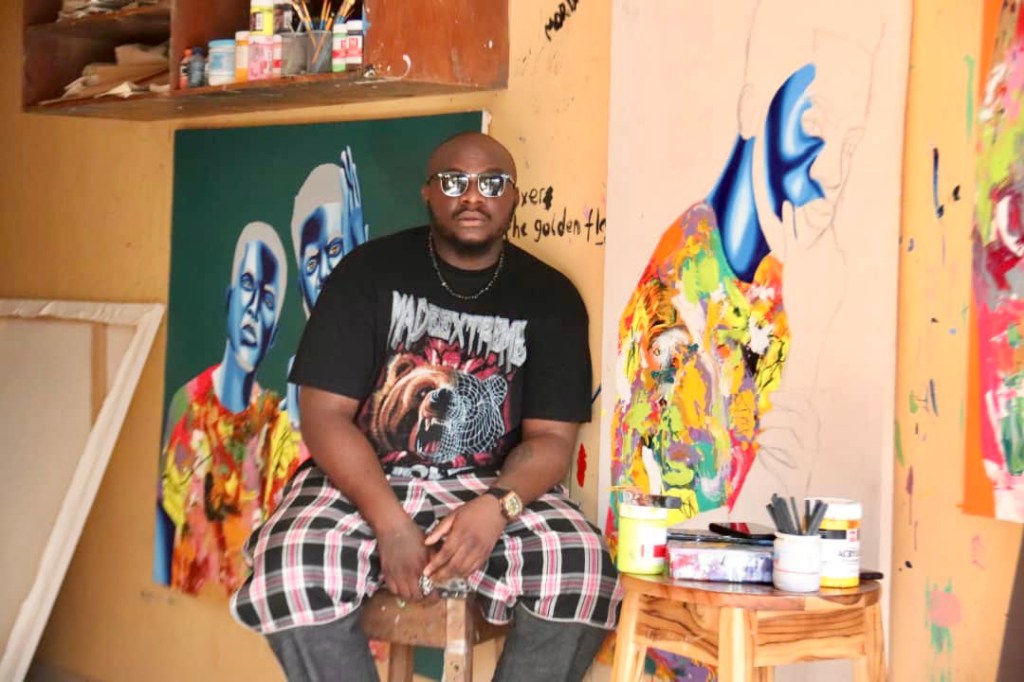
Introduce yourself in your own words
My name is Bara Sketchbook. To me, art is more than just having a purpose upon this earth. It is my own way of documenting everything around me. It is a way of leaving something behind so that when I am gone there is going to be some documentation about my life, about how I loved, how I lost and how I felt. That is who I am.
From the conception of your works to the materials, how would you describe your creative process?
As every creator, I try as much as possible to make sure that I am in total control of the process. When I stage my subjects, there does not need to be an emotional connection, I just need to be able to interpret my thoughts. What I usually do is take a photograph and use it as a reference for the canvas. My painting process is intentional: every brushstroke, every splash, every coat and color has a particular intention. I know exactly what I want to do.
I come from a very rich African heritage, my father is from Nigeria and my mother is from Sierra Leone, I’m through and through African. In my creative process, I want to communicate this heritage through the positions of my subjects. I want to communicate how my family is, how my tribes are. I want to paint our ups, our downs but also our good and bad moments. My last series is titled Ajayi’s People. It reconnects with the spirit of my mother who passed away last year. My tenacity as an artist comes from this woman and I want this heritage to be part of my creative process.
As for the materials, I mainly use acrylic on canvas. I love the vibrancy of acrylic colors and I have fallen in love with them since the first time I held a brush. I guess I am going to be using them for the rest of my life.
Could you describe one work of your choice?

This painting is titled Silas and Chioma. It is from the Ajayi’s people series.
Colors come easy to me, they appear easily in my head in an instant synesthesia. It feels spontaneous to be able to pair the orange of their hair with a turquoise background.
Silas and Chioma are two young people who are tired of what is going on around them. I painted it while Nigeria was going through a huge wave of protests against the political power and demonstrations against police violence. What I wanted to portray was the fatigue but also the confidence of the youth. Those two subjects will stand in front of you, no matter what. They are strong and resilient. In my last twelve paintings, I have only used two main colors for my subjects: purple because it expresses royalty and blue because it expresses pain.
What inspires you and what connection do you have to your art?
What inspires me is mostly the idea of being a human being. Sometimes I step away from my humanity to document it. You know when you are getting through a tough week of work, you tend to forget that there is beauty in those patterns. I love to document it, we’re caught up being humans. I really want this idea to be present in my next series, it is going to be completely different, completely new. I want to bring more humanity in a new way.
What does your work aim to say?
My work aims to talk about love, loss and lost love. As a human being, you must love and you will experience loss. You will lose people you loved when you were a human being. Nevertheless, at the end of the day, It do not mean you will lose the ability to love. Loss does not decrease your ability to love.
Interview by Maud Ntonga
—
If you would like to know more about him, see more works from him or stay in touch, please follow him on Instagram, check out his Artsy, or request a catalogue.
 Bwo Art